
I have been an investor in Pulse since November 2025. Specifically:
- I hold and stake the token, which I bought in both presale series.
- I use their investment products.
I’m writing this because a year of watching from inside is worth more than a paragraph copied from a landing page: daily Zoom calls, the token listing, the terminal from beta onwards. This is what I’ve seen, product by product, milestone by milestone.
This is the long version, with every number and screenshot. If you’re not sure what a prediction market is yet, start with the simple version of this review → It takes a few minutes and explains everything here in plain words.
What Pulse is
This is a Pulse Platform review from the inside. Pulse is building infrastructure for prediction markets. Today that means a trading terminal on top of Polymarket: the same markets, prices and resolution, in a different interface with its own tools. Around the terminal they are building an ecosystem: a token with staking, a liquidity product, an automated trading product, an ambassador program and a payment card, with their own exchange planned for late 2027.
The stated goal is to become the biggest platform in prediction markets by volume and audience. In September 2026 the terminal put through $2 million in a month, which placed it around 28th on a builders-by-volume leaderboard.
The five products, and it’s just the beginning
Pulse Market, the terminal
Status: live. This is the main product. You sign in, you see Polymarket’s markets in a different interface, you trade. It runs in the browser at pulsemarket.trade, on phone or desktop, in multiple languages. Pulse is a verified Polymarket builder, and its own explainer of how the terminal works is a fair place to start.
The thing it adds that Polymarket doesn’t have is the screener, shipped in September. It’s one table of every market with columns for price, change over one hour, change over 24 hours, spread, liquidity, 24-hour volume and closing date, and a filter on each. There are presets too: markets with no favourite, markets moving most, markets closing soon.

If you’ve read my guide to reading a Polymarket market page and the one on finding a market worth trading, you’ll recognise the columns. They are the four numbers I tell you to check before you touch anything: spread, liquidity, volume, closing date. On Polymarket you check them one market at a time by opening the order book. Here they sit in a list you can sort and filter. That is the whole case for the terminal in one sentence, and it’s a real one.
Three things worth knowing before you sign up, all from their own documentation and matching what I see in the cabinet.
Sign-in and keys. You sign in with a six-digit code sent to your email, or through Google. No password. The terminal creates a wallet for you and holds the key encrypted; if you registered by email you can export the private key yourself, and Pulse says it never asks for it. Trading runs through a separate Polymarket smart-contract wallet on Polygon that this key controls. Their security explainer covers this properly, including how to check your own trades on a Polygon block explorer.
Money in and out. USDC or USDT on six networks (BSC, Polygon, Ethereum, Base, Arbitrum, Optimism), minimum $10, with the conversion fee and price impact shown before you confirm. Withdrawal is the same route back. Their funding guide walks through it screen by screen.
The smallest trade is $1. On Polymarket directly the minimum order on the market I traded was $5. That matters for anyone doing what my guides recommend, which is learning with tiny stakes.
Also live: Pulse Points, credited for trading, with a promotion until 11 October 2026 that returns 80% of each trading fee as points. Planned and marked “coming soon” on their site: rule-based trade automation, an AI adviser, and API access.
The token
Status: listed, still in presale, and under a temporary name.
The token lives on BNB Smart Chain and trades on PancakeSwap, with a fixed supply of one billion and a public, verified contract. It went on sale in two series of eight rounds. Series A is closed: 160 million tokens for $925,200. Series B is running now, round five of eight at $0.00625.
| VIRUS2027 / PULSE, as published by Pulse | |
|---|---|
| Chain, standard | BNB Smart Chain, BEP-20, traded on PancakeSwap V2 |
| Supply | 1,000,000,000, fixed, no further issuance |
| Who holds what | Series B presale 64%, Series A 16%, exchange liquidity 7%, staking fund 5%, marketing 5%, team 3% |
| Series A | Closed. 160M tokens raised $925,200. Unlocks about 5% a month over roughly 20 months |
| Series B | Live. 8 rounds from $0.0025 to $0.00906; round 5 at $0.00625 when checked. Unlocks about 2.5% a month over roughly 40 months, starting only after all 8 rounds close |
| Buying on the market | PancakeSwap V2, about $0.015 when checked. No lock: buy and sell any amount at any time |
| Buying in the presale | Cheaper, currently $0.00625, but vested: nothing sellable until all Series B rounds close, then about 2.5% a month |
| Staking | Locks of 3 to 24 months, rate rises with term; rates on the token page. Paid weekly in the token from a 50M-token fund topped up by buybacks |
| Where presale money goes | Liquidity 35%, marketing 35%, development 10%, buyback 10%, operations 5%, reserve 5% |
| Burned so far | 25.4M tokens, 2.54% of supply, about $384,000 at the time. Mostly team and founder allocations; fee-funded burns about 210,000 |
checked 25 september 2026 against pulse-platform.io/hub/token and the cabinet. presale rounds and prices move, and the token page is the source of truth.
There are two ways in, and they are different trades.
- Buy on PancakeSwap and you pay the market price, and you can sell any amount at any moment. No lock, no schedule. It’s a token on an exchange like any other.
- Buy in the presale and you pay well under half of that, and in exchange you accept vesting. Series A unlocks at about 5% a month over roughly 20 months. Series B unlocks at about 2.5% a month over roughly 40 months, and the clock only starts once all eight rounds have sold. Buy in round five today and you cannot sell anything until round eight closes, then 2.5% of your holding a month for over three years.
So the discount is real, and you pay for it by waiting. Which route makes sense depends on whether you want to be able to sell.
Staking locks tokens for three to 24 months and pays weekly, in the token, at rates that rise with the lock term. The rates are on their token page. What matters more than the rate is where the money comes from: a staking fund of 50 million tokens, 5% of supply, which the company tops up by buying tokens back with terminal revenue. The payouts last as long as the fund does, and the fund lasts as long as the terminal earns enough to refill it.
Burning is happening, and the dashboard shows who did it. As of late September, 25.4 million tokens have been burned, 2.54% of supply, worth about $384,000 at the time. The burn table lists every participant. The team account burned 14.4 million and the founder’s account 9.9 million, so those two are most of it. Burns funded from platform fees come to about 210,000 so far, and community members have burned smaller amounts of their own. The next cycle runs on a countdown and had 929,000 tokens accumulated when I looked. Every burn goes to an address nobody controls and can be checked on BscScan.

About the name. It trades as VIRUS2027 and the legal pages call it PULSE. Same token. VIRUS2027 is a marketing name for a campaign through 2027 (the page gives two versions of what the letters stand for and says outright that “marketing here is part of the product”), after which it reverts.
My own holding. I hold both series. I was in from the first round of Series A at $0.0025, and I bought into Series B as well. The dashboard shows 1,487,652 tokens: 1,351,542 still vesting and 136,109 staked. When the token listed in June, Series A holders were offered an early unlock of part of their holding with the option to stake it for 24 months at the premium rate; mine was 40,719 tokens, and I took it. The rest unlocks at 1,022 tokens a day, and every day I move that day’s unlock by hand into a 20-month staking position, which now holds 95,391. Staking rewards so far, 17,323 tokens, have all gone back in rather than out.
Tedious, and I think that’s the point: it keeps you looking at the dashboard every day.

Pulse Liquidity
Status: live. I have liquidity placed in it, so this is described from their documentation, the public dashboard and my own cabinet.
What it does. Every Polymarket market is an order book: a list of people waiting to buy slightly below the current price and people waiting to sell slightly above it. A market maker keeps both sides of that list filled. When traders buy and sell against those orders, the market maker keeps the gap between the two prices. Pulse Liquidity runs that strategy and lets you put money into it.
Where the income comes from. Pulse names three sources, all paid by Polymarket’s own rules:
- The spread. The gap between the buy and sell price, earned every time an order fills.
- Liquidity rewards. Polymarket pays extra to whoever keeps tight prices on both sides of a market.
- Fee rebates. Since March 2026 the traders who take a price pay a fee, and part of it goes back to whoever posted that price. That’s the other side of the fee I measured on my own trade.
Why you’d use a product instead of doing it yourself. Market making needs software that updates prices in milliseconds, enough capital for the rewards to matter, and someone watching the book around the clock when news breaks. Small accounts doing it by hand get filled last.
How it works for you. You choose a term from 3 to 24 months and place USDT. Income is paid weekly, every Friday, and you can reinvest it. A longer term pays at a higher rate; the rates are on their page. Pulse says the strategy’s income is split roughly 75% to liquidity providers, 17% to the team running the orders, and 8% to the platform.

Pulsar, the automated trading product
Status: live since 20 August 2026. I hold several contracts. This is the one I can describe from the inside, and it works differently from a deposit, so read the mechanics before the rest.
Pulsar is the name of the algorithm; the product it powers is sold as “Trading”. The idea is simple: be faster than everyone else.
Here’s an example of the kind of moment it looks for. A market asks: “Will Bitcoin be above $80,000 at 3:00 pm?” It’s 2:59, and Bitcoin is already well above $80,000. The answer is almost certainly Yes. But the people trading that market haven’t updated their orders yet, and someone is still selling Yes at 90¢. Pulsar sees the real Bitcoin price a moment earlier than they do, buys at 90¢, and a minute later each share pays $1.
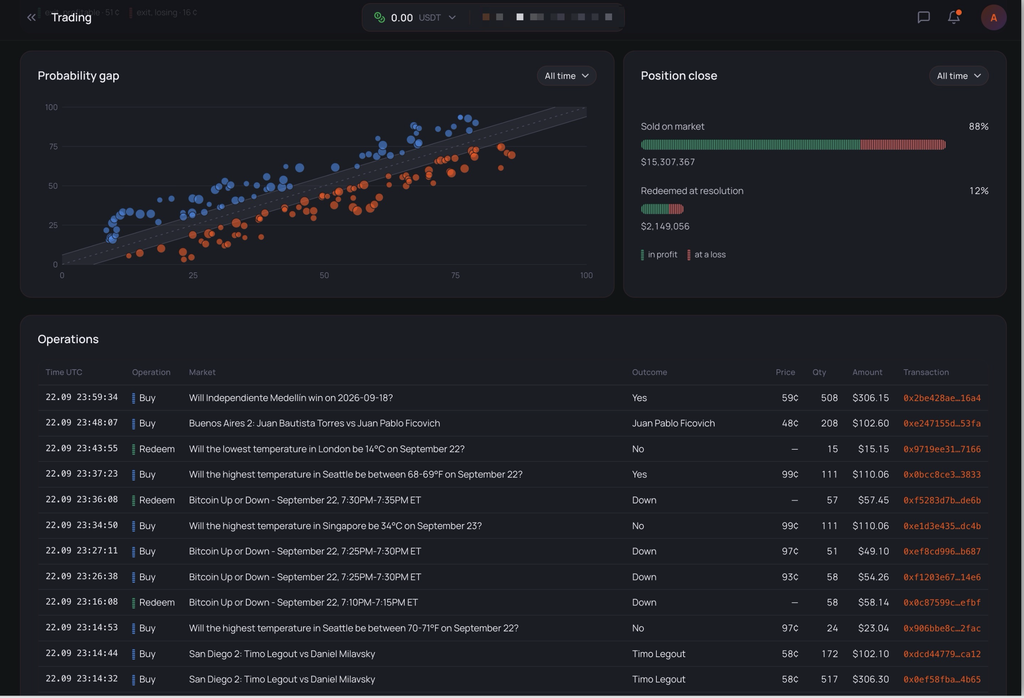
That’s the whole trick, repeated thousands of times across crypto, sports, weather and other markets. Pulse calls it the “probability gap”: the moment when the price on the market lags behind what’s actually happening in the world. The founder compared it to the early days of crypto, when you could buy Bitcoin on one exchange and sell it for more on another.
The algorithm does the watching. It checks more than 10,000 markets, picks a few dozen worth trading, and decides how much to put into each. It ran on the company’s own money from early 2026 before investors could buy in.
The part I’d underline is what the founders said about how long this lasts. Gaps like these close as more fast traders arrive. In their own words, they see a couple of good years ahead, and in three to four years the strategy may stop working. That matches what I wrote above about early markets, and it’s the founders saying it, not me.
How the contract works. You don’t deposit money and earn on it. You buy a contract for an amount of your choosing, from $50 up, with no stated upper limit. Algorithms, including work on prediction markets, trade on the system’s side; you don’t pick entries or manage risk. Payouts accrue weekly, on Tuesdays. The contract runs until the total paid out reaches 200% of what you paid for it, then it ends. You can’t exit early: once bought, a contract runs until it reaches the cap. There is no separate principal that comes back at the end: the 200% is everything. When it closes you decide whether to take the money or buy a new contract.
Two tiers. Standard is what you get when you buy with new money. Premium is what you get when you buy a contract out of payouts you’ve already received, and it pays at a higher rate. The company publishes expected rates and an expected time to reach the cap for each tier, calls both expectations rather than guarantees, and I’ll leave those figures on their page rather than repeat them.
How the money is split. Everything the algorithms earn is divided between contract owners and Pulse: roughly 70 to 30 on Standard and 80 to 20 on Premium. The cabinet shows both sides on every contract, which I appreciated: nothing is netted out of sight. Your payouts, and the 200% cap, are your side of the split. Pulse says its share pays for developing the algorithm, data providers, servers and the partner program.
You can’t top up a contract. Payouts can’t go back into the contract that paid them. What you can do is buy a new contract with them, and that is the only way the money compounds.
Here’s my first contract, bought on 29 August.

What the money is doing. The cabinet has a page called Trading Bridge that shows the whole pool, not just your slice. On 23 September: $3.1 million of capital at work, $17.5 million traded, 122,617 trades with an average size of $142, held for 1.8 days on average. Income so far $379,921, split $282,368 to contract owners and $97,553 to the company.

Where it trades: 35% of volume in sports, 19% weather, 17% crypto, 14% politics and elections, 9% macro, the rest world events. Average entry at 40¢; winning positions exit around 51¢ and losing ones around 16¢. 88% of positions are sold back to the market before resolution and 12% are held to the end.
And every operation is listed with its time, market, side, price, quantity and a transaction hash you can open on-chain. I spot-checked a few. That is more transparency than I’ve seen from any yield product in crypto, and it’s the reason I’m comfortable describing this one.
Why these products can pay at all
Before the two yield products, one thing I want you to understand, because it explains both where the money comes from and why I don’t expect it to last.
Prediction markets are a young market, and young markets are inefficient. Prices on the same question drift apart, order books are thin, and there aren’t yet enough professional traders to close every gap the moment it opens. Whoever has the software and the capital to work those gaps gets paid for it, and right now that pay is unusually good.
It won’t stay that way. Crypto went through the same thing: in the early years the same coin traded at noticeably different prices on different exchanges, and buying on one and selling on another was a real business. Then more capital and faster bots arrived, and the gap closed. I expect prediction markets to follow the same path. So read what follows as a description of an early window, and expect what these products pay to come down as the market matures.
| Liquidity | Pulsar (trading contracts) | |
|---|---|---|
| What your money does | Market making on Polymarket: keeps buy and sell orders in the book | Algorithms trade prediction markets for the pool |
| You put in | USDT, for a term you choose | From $50, no stated upper limit |
| Term | 3, 6, 9, 12 or 24 months | No fixed term: runs until it hits its cap |
| Paid out | Weekly, every Friday | Weekly, every Tuesday |
| Your original money comes back | In full, on the last day of the term, automatically | It doesn’t come back separately. Payouts are everything you get, up to 200% of what you paid in total |
| When you’ve got your money back | On the term’s end date | When payouts add up to 100% of what you paid. How fast depends on how the algorithms do |
| Can you take it out early | No, it’s locked for the term | No, the contract runs until it reaches its cap |
| Reinvest | Yes, payouts can be added to your balance | Not into the same contract. Payouts can buy a new one |
| Rate | Higher for longer terms and for Premium. The rates are on Pulse’s pages for liquidity and trading; I don’t repeat them here, because they’re expectations, not promises | |
the two rows in yellow are the ones people mix up. read them twice.
The ambassador program
Status: live for three products, with the terminal coming. This is how Pulse markets itself, the way most of crypto does: Binance, Bybit and Polymarket itself all pay for referrals. Pulse’s version goes deeper than most, and the rules are public on their page, so I’ll summarise them.
Two income channels. Linear pays instantly on every purchase made by the people you referred, and by the people they referred, down the chain: 10% on your direct referrals, 5% on the next two levels, 3% on levels four to eleven, with how many levels you’re paid on set by your status. Pools pay weekly: the company sets aside a slice of turnover on each product (2.25% of token purchases, 1.25% of liquidity, 1.5% of liquid staking into fifteen pools, and each pool is shared among people whose status opens it, weighted toward teams that hit a weekly volume target.
Status runs from Start through VIP-1 to VIP-10 and then Ambassador, Director, Partner, Shareholder, Co-founder. Your own purchases and your team’s volume unlock it, and the top of the ladder needs $1 million personal and $100 million in team volume. There’s also an “Early Boost”: buy enough yourself and you get a status upfront for 30 days.
Today the program pays on token purchases, liquidity and liquid staking. Terminal trading is listed as “soon”. So right now an ambassador earns when the people they bring in buy the token or put money into the yield products, and not yet when they trade.
The card
Status: planned. A crypto card for spending and instant exchange, advertised with “100% cashback”.
Who is behind it
Two companies. Pulse Platform Payment Solutions sp. z o.o. in Poland (KRS 0001138693) holds a Virtual Asset Service Provider registry entry, RDWW-1658, and runs the trading platform and payments. Pulse Platform AI Corp in Panama (registration 21,948) handles the token, exchange listings, the ambassador program and international partnerships. A Canadian entity with an MSB licence is on the roadmap for early 2027.
The team’s backgrounds run through blockchain, AI, fintech and international business. They aren’t only names on a page: they’re on Zoom every week, talking about plans, what shipped, and what didn’t. You can ask questions and they answer, including the inconvenient ones.
The Roadmap
Pulse’s roadmap as they publish it, quarter by quarter. Titles and wording are theirs. Blue dots are quarters that have passed; gray dots are still ahead.
source: pulse-platform.io/hub/roadmap, page version dated 9 July 2026, copied 16 October 2026
Insight
- Spotted the new trend — prediction markets
- Reliable sources confirmed it: the market is set to grow multifold
- Studied the market, dissected our own trades, held talks
- Registered a company in Poland — the legal foundation
Testing
- Entered the market hands-on: our own trading strategies
- Broke down trading mechanics and market structure
- Built analytics on trades and venues
- Studied the prediction-market user (custdev)
Course set on an ecosystem
- Decided to build our own ecosystem — with our own token
- Shaped the architecture: terminal, token, liquidity, ambassador program
- Worked out the concept and mechanics of every product
- Started preparing the launch of our own platform
Preparation
- Founded the second entity — Pulse Platform AI Corp (Panama)
- Locked in the roles: token issuance, listings, ambassador program
- Prepared the entire technical infrastructure
- Reached full readiness for the public launch
First touch with the market
- Launched the public token sale — Series A
- The first major leaders joined us
- Held the ecosystem’s first online event
- Publicly stated our goals, strategy and plan for the first time
Product launches
- Launched the liquidity product — Pulse Liquidity
- Opened the Liquidity Bridge — transparent strategy statistics
- Launched the Pulse Market terminal beta
- Tested actively and gathered the first feedback
Quality growth
- Shipped the new version of the client cabinet
- Held the first offline events: Dubai and Phuket
- Took the VIRUS2027 token to listing — open trading
- Launched the full version of Pulse Market
Growth begins
- Held the first top-leader gathering — offline in Turkey
- Launching: liquid staking · trading · equity — a share of the terminal
- Upgrading the Liquidity Bridge — even more transparency
- Leveling up the terminal: affiliate · scanner · auto-trading · cashback
Scaling
- The official large-scale start — the company’s birthday
- International expansion: advertising, influencers, partnerships
- An event bootcamp for the company’s ambassadors
- Actively embedding AI into every aspect of the ecosystem
Top-company status
- A closed event for top ambassadors with the founders — Dominican Republic
- A new entity in Canada: MSB licence, FINTRAC registration
- Top-10 Polymarket builders and partner status
- Opening the first international Pulse offices
Token growth
- VIRUS2027 listed on top exchanges
- Establishing the Pulse Foundation
- Launch of the Pulse Card line
- Copy-trading
Technology and visibility
- A major international Pulse forum — thousands of attendees
- Collaborations and celebrity partnerships
- Launch of trading AI agents
- Registering new legal entities and obtaining local licences
Our own infrastructure
- Launch of our own prediction market
- Proprietary market-making infrastructure
- An anniversary event — the whole ecosystem gathers
- Marketing expansion: bloggers, B2B, new markets
2028 to 2030: Pulse says these years are being planned now and will be published as each step takes shape.
The growth has been fast. I remember the first dashboard was, to put it mildly, very simple. Within a few months of my joining it became something close to top-tier, and it keeps updating. In November they were talking about a terminal beta and the first liquidity product; both shipped quickly. The one thing that slipped was the token listing, and that was more or less expected.
Why I’m still here after a year
I believe in prediction markets as a new era, and in being early to an industry this size. I like that this is a startup unfolding in front of me, and that in a year I haven’t seen a red flag: promises kept, constant contact with the community, weekly zooms on how to use the terminal, what’s happening in prediction markets, what the company is planning next. And I like that there’s something here for everyone: for traders, for people who believe in the company and want the token, for people who just want to invest and use the products, and for people who want to build on it.
Pulse grows through its ambassadors by design, and says so openly: for the company that’s the marketing, and for the person it’s a second way to earn on top of whatever they hold. The program pays from the first direct referral, and the larger part of it opens up with team volume, so it rewards people who bring and support a team rather than people who post a link once.
FAQ
Is Pulse a prediction market?
Not yet. It’s a terminal that trades Polymarket’s markets. Its own exchange is planned for late 2027.
Is Pulse regulated?
The Polish entity holds a VASP registry entry, which covers crypto-asset services. That is not a prediction-market licence. A Canadian money services business registration is planned for 2027.
What is VIRUS2027?
The temporary name of the Pulse token, used for a 2027 marketing campaign. It reverts to PULSE afterwards.
Does Pulse have a referral program?
Yes, an ambassador program paying on token purchases, liquidity and liquid staking, with terminal activity to follow. The full rules are on their site and summarised above.
Can I use Pulse from the US or UK?
The terminal is reachable from anywhere.
I am an early investor in Pulse. Nothing here is financial advice. Prediction markets involve real risk, so never trade money you can’t afford to lose.