
Polymarket has thousands of markets and a front page that sorts them by how much attention they’re getting. Attention is the thing that removes your advantage, so the front page is organized against you.
Guide 4 of 5. Screens as of August 2026. Covers Polymarket Global.
The awkward thing nobody mentions
Two forces here pull in opposite directions.
Your edge is largest where fewest people are looking. On a bill in your industry, or a league you actually follow, you might know something the crowd doesn’t.
Liquidity is largest where everyone is looking. Busy markets have penny spreads and deep books, so trading them costs almost nothing.
So the market where you know most is usually the one that costs most to trade, and the cheapest one to trade is where you’re the fifty-thousandth person reading the same headline.
I’ll be honest about how that resolves, because the cheerful version of this advice is wrong. Being right on an illiquid market is often worth nothing. If the spread is thirty cents and nobody’s there when you want out, a correct forecast doesn’t convert into money, it converts into a position you’re stuck with. So for most people starting out, the overlap between “I know something” and “I can trade it” is genuinely small, and sometimes empty.
That isn’t a reason to force it. It’s a reason to watch a lot and trade rarely. Which is the opposite of what the interface encourages, and roughly the whole point of this page.
Four checks before you get interested
Four checks, in this order. Each one takes longer than the one before it, so the early ones do the eliminating and you only spend real attention on what survives.
Filter 1: the clock
This comes first because it decides whether you’re competing at all.
Short-dated markets (“BTC Up or Down 5m”, live sports, hourly price bets) resolve on a clock, and the fastest reader wins. The fastest reader is software. A human trading five-minute crypto isn’t competing, they’re donating, and the piece on your counterparty explains why.
Skip anything resolving in minutes or hours. Not because you’d always lose, but because speed is the only edge on offer there and you don’t have it.
Weeks and months work the other way round. Nothing needs to happen fast for the next ninety days, so speed is worthless and judgment is the whole game.
Filter 2: what you know
The interface presents every market with identical confidence. A question about Ethiopian politics looks exactly like the sport you’ve watched every weekend for a decade, so you have to make the distinction yourself.
The test I’d use: could you argue the other side? If you can explain why someone smart is taking the opposite position, you understand the question. If the other side just seems obviously wrong, you’re probably missing what they know.
Pick one or two categories where you’d have an opinion even with no money involved. Ignore the rest for now.
Filter 3: the rules
Open the market, go to the Rules tab (some markets label it Resolution), and finish this out loud:
“This pays out if ___ happens, decided by ___, before ___.”
The Clarity Act market from guide 3 fills all three easily: passed by both chambers and signed into law, per Congress.gov’s tracker, by December 31 at 11:59 PM ET.
If a blank stays fuzzy, close the tab. A vague market can’t be traded well no matter how right you are about the world, because you’re carrying a risk that has nothing to do with the outcome and nobody is paying you for it.
Glance at the Additional context box and its date while you’re there. Rules amended after you trade still apply to you.
Filter 4: who’s there to trade with
Polymarket puts liquidity right in the listings, beside volume, as $X Liq. So you can filter before opening anything.
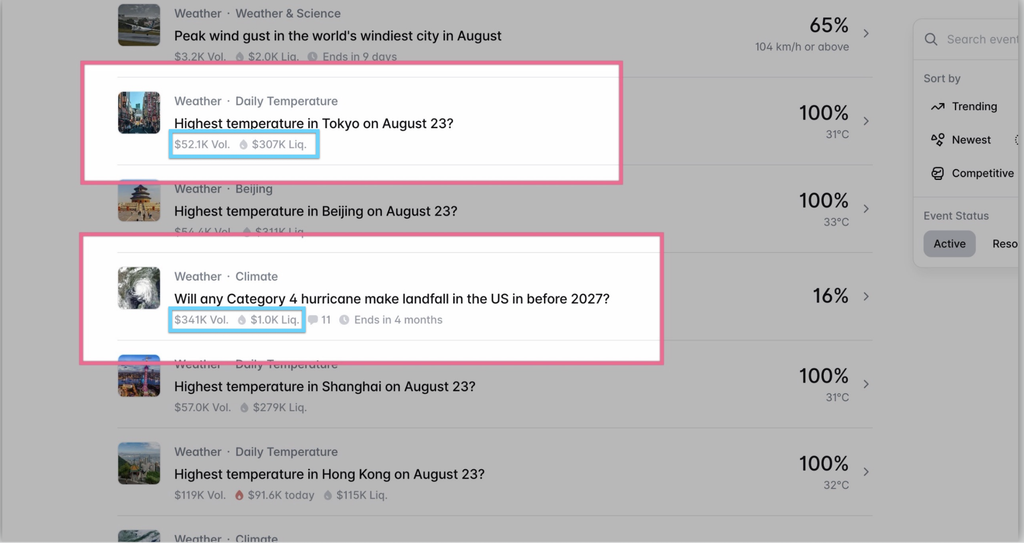
Two lines from the same category page:
| Market | Volume | Liquidity |
|---|---|---|
| Category 4 hurricane before 2027 | $341K | $1.0K |
| Highest temperature in Tokyo | $52.1K | $307K |
The hurricane market has traded three hundred times more than the Tokyo one, and has a thousand dollars behind it today against Tokyo’s three hundred thousand. Volume is a history of activity. Liquidity is who’s here now. Change Sort by from Trending to Liquidity and the list reorders itself around the second question.
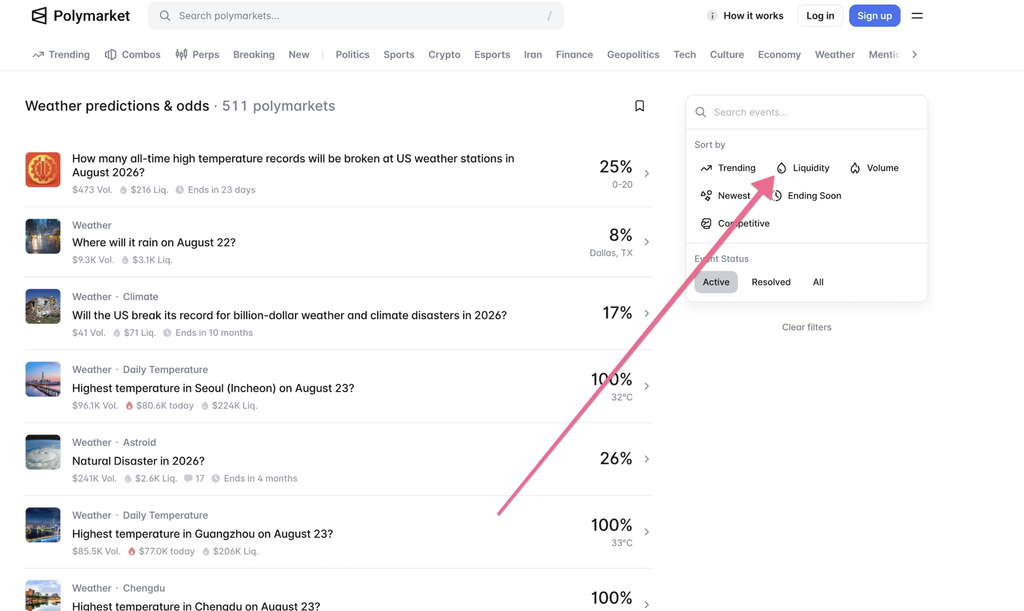
What thin actually looks like. Here’s a weather market with $216 of liquidity.
The headline says 25% chance. Buying costs 42¢.
Those aren’t the same number. 25¢ is the last trade that happened; 42¢ is what someone will actually sell you. On a busy market they sit a cent apart. Here they’re seventeen cents apart, and the advertised percentage is a museum piece.
The order book explains it. The spread is 33¢. There are 6.96 shares at the best ask, worth $2.92. And the entire buy side of this market, every order at every price, comes to $6.38. You could move it with pocket change, which also means nobody will be there when you want out.
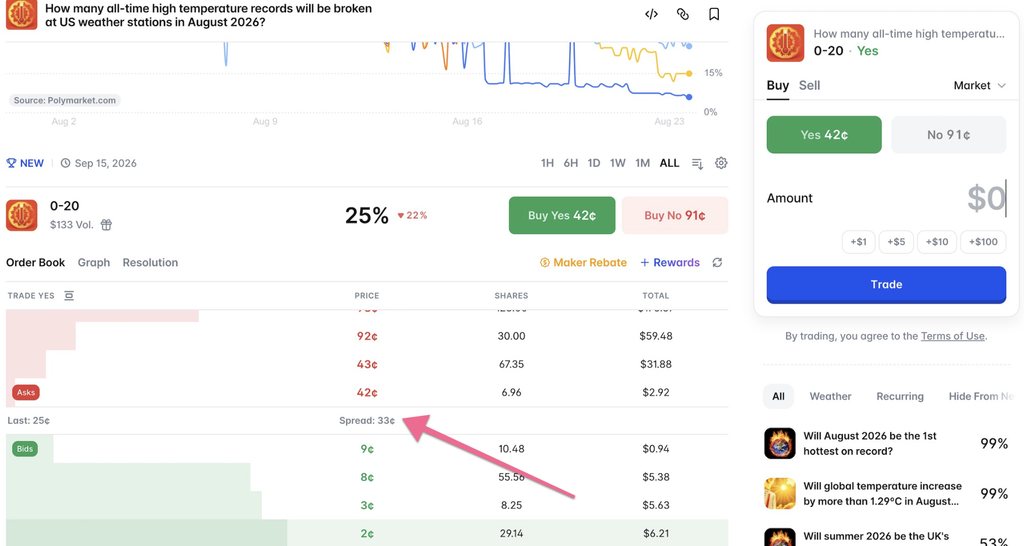
So check the Liq. figure before you get interested in a question. Then, on anything still standing, add Yes and No together. If they come to 133, you’ve found a market that will take your money in and refuse to give it back at anything near what you paid.
The technique worth more than any filter
The sidebar on every market page lists related questions with their prices. That’s where a slow thinker beats a fast machine.
On the Clarity Act page, priced at 25%, the neighbors were:
- H.R. 22 (SAVE Act) signed into law in 2026 — 6%
- Will AI-chip export licensing become law this year — 35%
- Crypto Market Structure legislation becomes law in 2026 — 36%
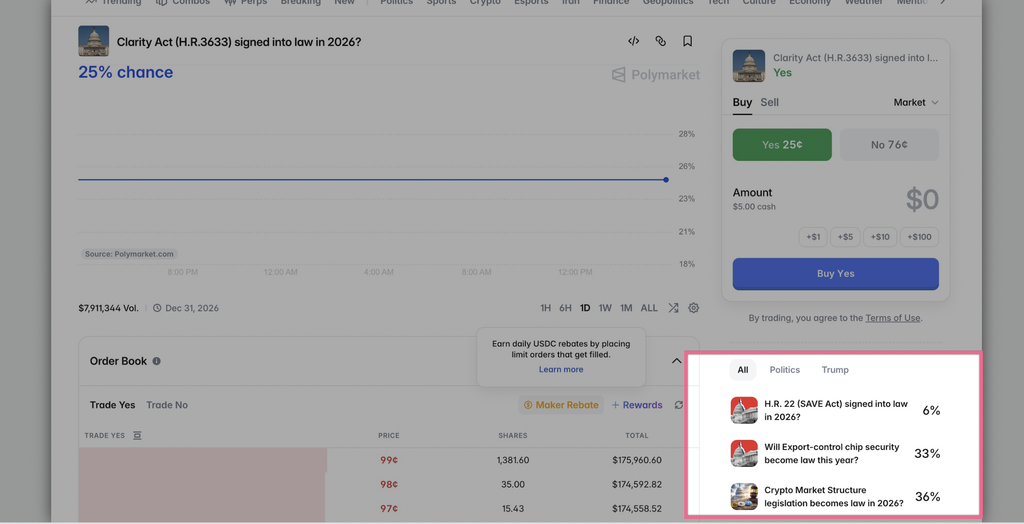
Read the first and last together, because those two aren’t neighbors, they’re relatives. The Clarity Act’s full name is the Digital Asset Market Clarity Act, and it is crypto market structure legislation. One market asks whether this particular bill becomes law. The other asks whether any bill of that kind does.
The second contains the first, so the broader price should never sit below the narrower one. It doesn’t: 36 against 25. The market is internally consistent, and the eleven-point gap means something you can interrogate. It’s the price of “some other crypto market structure bill passes instead of this one”.
So ask whether eleven points is right. If you follow this area and think H.R.3633 is the only realistic vehicle this session, those numbers should be much closer, and one is mispriced. If you can name two or three live alternatives, the gap looks about right.
Before acting on it, open the rules of both. The nesting only holds if the broader market actually counts the narrower bill as qualifying. Two minutes, and it’s the difference between an insight and a hunch.
This is the most reliable edge available to someone who isn’t fast. You don’t have to forecast the world better than everyone. You have to notice when two prices can’t both be right, and work out which one you’d have to be wrong about.
Watch before you trade
Click the bookmark icon at the top of a market page and it’s saved. To see your saved markets, use the bookmark icon in the All markets header on the front page, which filters the list down to them. There’s no separate watchlist page.
Pick three or four markets that pass the filters above and follow them for a week without trading. You’ll see how the price moves on news and how wide the spread gets when nobody’s around. Free, and more useful than any first trade.
The urge to trade the first market that looks interesting is the expensive version of the same curiosity.
What to skip while you’re learning
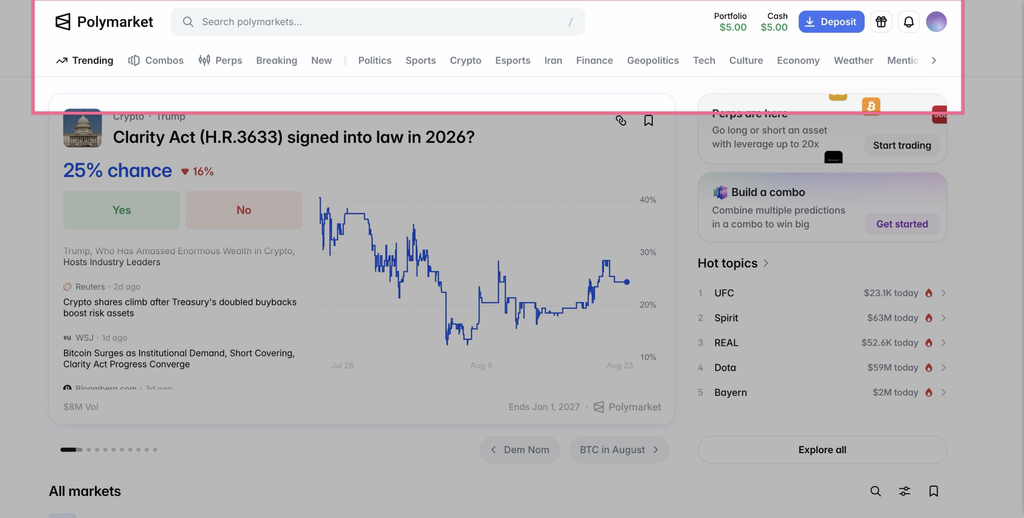
Trending, Hot topics, Breaking. All three rank markets by how much attention they’re getting, and attention is exactly what removes your advantage.
Combos. Polymarket promotes combining predictions to “win big”. Stacking picks multiplies the odds against you, and three separate 75% legs come to a 42% shot.
Anything you found through somebody’s winning screenshot. By the time a market is being posted about, the price contains the story.
Markets you had no opinion about ten minutes ago. If the market gave you the opinion, the market is not where you’re going to make money.
FAQ
How do I find markets on Polymarket?
Search at the top, or browse the category menu. Change Sort by from Trending to Liquidity, Volume, Newest, Ending Soon or Competitive depending on what you’re after.
What’s the best kind of market for a beginner?
Something resolving in weeks or months, in a subject you’d follow anyway, with clean rules and a spread near 100. Short-dated markets like five-minute crypto are dominated by automated traders.
How do I tell if a market is liquid enough?
Check the Liq. figure in the listing, then add the Yes and No prices on the market page. Near 100 is tight. Then open the order book and compare what’s resting at the best price against what you plan to trade.
Why is the price on the market page different from what I’d pay?
The headline percentage is the last trade. What you pay is the best current ask. On busy markets they’re nearly the same; on thin ones they can be seventeen cents apart.
Can I follow a market without trading it?
Yes. Bookmark it from the market page, then filter the market list by bookmarks using the icon in the All markets header.
Nothing here is financial advice. Prediction markets involve real risk, so never trade money you can’t afford to lose.