
A prediction market shows you a single number, say $0.65. Almost everything you need is packed into it if you know how to unpack it. Most people don’t, and it quietly costs them money. By the end of this, you’ll read that screen better than a lot of the people trading on it.
The basics: price = probability
Every contract pays out $1 if the outcome happens and $0 if it doesn’t. So the price is the market’s estimate of the probability.
A Yes contract at $0.65 means the crowd is collectively saying there’s about a 65% chance. Pay $0.65, and if you’re right, you get $1 back, a $0.35 profit. If you’re wrong, that $0.65 is gone.
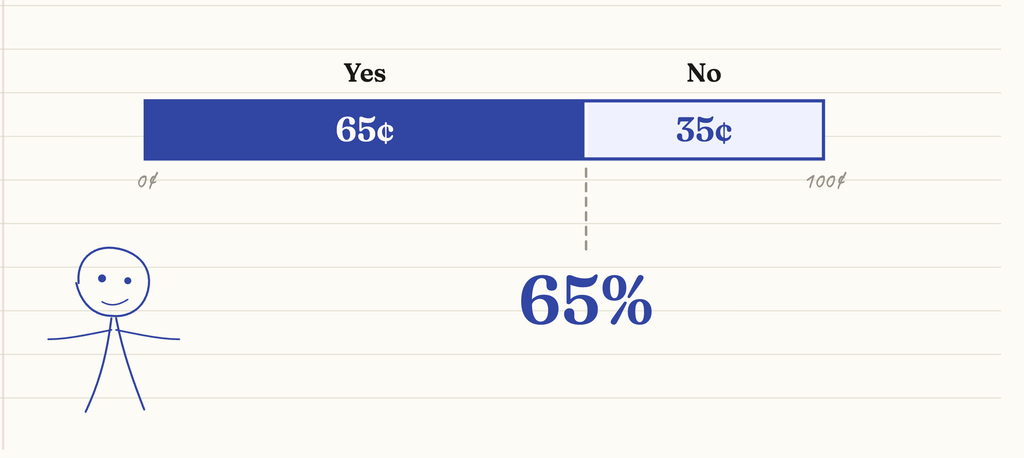
That’s the whole mechanic. Two things fall out of it.
Yes and No always add up to roughly $1. If Yes trades at $0.65, No sits around $0.35. Buying No at $0.35 is the same bet as saying the probability of Yes is below 65%.
And cheap doesn’t mean good. A contract at 4¢ looks cheap, but all it’s telling you is that the market puts the odds at 4%. Long shots are tempting for the same reason lottery tickets are, that shiny 25x payout. The question is never how big the payout is. It’s whether the true probability is higher than the price.
Your real question: Is the market wrong?
You only profit when you disagree with the price and you turn out to be right. Buying Yes at $0.65 pays off only if the real probability is higher than 65%.
It’s also why saying the market was wrong after a single event is usually a misread. A 70% favorite still loses three times out of ten. One outcome proves nothing. A probability is just the odds, and the odds are allowed to lose.
The spread: the price of impatience
Look closer at any market and you’ll see two prices: the highest anyone’s offering to buy (the bid) and the lowest anyone’s asking to sell (the ask). The gap between them is the spread.
In a busy market, say a major election or a big game, the spread is a cent or two. In a quiet one it can be brutal: bid $0.30, ask $0.45. That gap is what you pay for getting in and out quickly.
A wide spread means thin liquidity: not many participants, and not much money on the books. Two things follow. First, in a thin market the price is barely a forecast at all, because one trader can shove it around, so treat it as a rough sketch rather than the wisdom of crowds. Second, check that you can actually get out. A position you can’t sell at a fair price quietly turns back into a locked bet, which is the exact thing prediction markets were supposed to fix.
Three ways the rules bite you
trap 1
The extra-time trap
Argentina won a World Cup match in extra time. The market resolved No, because its rules only counted the result after 90 minutes.
the event happened. the written one didn’t.
trap 2
The source that changes its mind
Player stat markets resolve against official box scores, and those get corrected hours after the whistle.
a number you watched can legally change.
trap 3
Sale versus announcement
Strategy sold 32 BTC between May 26 and 31, inside the window. The filing confirming it landed June 1, a day after the deadline.
the sale and the proof are two events.
All three come down to the same habit. The event you have in mind and the event written into the rules are not always the same thing, and the market pays out on the written one. Work out which one it is before you click.
A pre-trade checklist
Thirty seconds before any trade, run through this:
- What exact event do the rules describe, and is it the event I actually think I’m predicting?
- What’s the resolution source, and can it be revised or delayed past the deadline?
- What’s the exact deadline, and in which timezone?
- How wide is the spread, and is there enough liquidity to get out?
- Is the true probability, as honestly as I can estimate it, meaningfully different from the price?
If any of those answers is fuzzy, the trade is a coin flip wearing a spreadsheet’s clothes.
Most of the losses people blame on bad luck are really a skipped read of the resolution rules.
Why these disputes keep happening, and who actually gets to decide, is the deeper story: Resolution: The Risk Nobody Prices In.
Nothing here is financial advice. Prediction markets involve real risk, so never trade money you can’t afford to lose.