
Buy a contract at 18¢, change your mind, and sell it a second later at 17¢. You’re down about 12% on a market that never moved.
Half of that is the penny, measured against the price you paid rather than against a dollar. The other half is a fee the screen never mentions.
The clicking part of a first trade takes ten seconds. This guide is about the arithmetic around it, and about how to get back out.
Guide 5 of 5. Screens and prices as of Sep 13 2026. Covers Polymarket Global.
The trade in this guide was placed on Merz out as Chancellor before 2027, buying at 18¢ with the best bid at 17¢.
Taker fees at the time of writing: 0.04 on politics, finance and tech, 0.05 on sports, economics, culture and weather, 0.07 on crypto. Makers pay nothing, and geopolitical markets carry no fee at all.
the fee rates change rarely, the prices change hourly. every percentage on this page is a snapshot of one afternoon.
Before you click
You’ve read the earlier guides, so this is the checklist in one place.
- The rules. What resolves this, decided by whom, by when. Check the Additional context box and its date. (Guide 3)
- The spread. Add Yes and No. Near 100 is tight. (Guide 3)
- The book. Is there enough resting at the best price to fill you without moving it? (Guide 4)
- Your size. Decided before you looked at the price. (How much to bet)
- Your reason. One sentence: “I’m buying Yes at X because I think the true chance is Y, because ___.”
If that last sentence is hard to write, you don’t have a trade yet. You have an interest.
Two costs, and one of them isn’t labelled
Run it with real money. Put $5 into a contract at 18¢ and you get 27.8 shares. Sell them straight back at 17¢ and you get $4.72. That’s the spread: 28 cents gone, about 5.6%, and nothing happened.
Then there’s the part nobody points at.
Polymarket charges a fee when you buy or sell at the price already on offer. It’s called a taker fee, because you’re taking a price someone else put there. The formula is published, just not anywhere you’d bump into it:
fee = number of shares × rate × price × (1 − price)
The rate is 0.04 on politics. The price × (1 − price) part looks worse than it is, and all it does is make the fee biggest on markets sitting near 50/50 and smallest on markets near 1¢ or 99¢.
For this trade: buying 27.8 shares at 18¢ costs 16 cents in fees, and selling them back at 17¢ costs another 16 cents. Add that to the 28 cents of spread and the round trip is 60 cents on a $5 stake, close to 12%.
Where it shows up on screen
It isn’t hidden, exactly. Look at the order panel. The button says Yes 18¢. Two lines below, the panel says Avg. Price 19¢. Nothing on the screen explains the gap between those two numbers.
Here’s the gap. My $5 bought 26.7 shares. At a flat 18¢, $5 buys 27.8. The missing shares are the fee, taken out before the shares are counted, which is why the average price you paid comes out higher than the price on the button you pressed.
You can check it against your own balance afterwards, which is what convinced me. My cash went from $5.00 to $0.04, so $4.96 left the account. The position says Traded $4.80, which is 26.7 shares at 18¢. The 16 cents between those two numbers is the fee, and it matches the formula to the penny.
So the fee is on screen. It’s on screen as a one-cent difference in a line most people read as rounding.
Two more things follow, and the second one surprised me.
The fee is charged in dollars, and it peaks at 50¢. It’s largest where the market is most uncertain and shrinks toward both ends. So as a share of what you put in, a cheap contract is punished twice: the penny is a bigger fraction of a small price, and the fee still takes its cut.
| Contract price | The spread | What the round trip costs |
|---|---|---|
| 90¢ | 1.1% | 1.9% |
| 50¢ | 2% | 6% |
| 18¢ (this trade) | 5.6% | 12% |
| 5¢ | 20% | 27% |
$5 in and straight back out, buying at the ask and selling one cent lower. middle column is the spread on its own. right column adds the taker fee, which no button on the screen shows you.
Only one side pays. If you take a price that’s already there, you pay. If you post your own price and wait for somebody to come to you, you pay nothing. That’s the difference between a market order and a limit order, and it’s worth more than it used to be. More on it below.
There’s one exception worth knowing before you pick a market to practise on: geopolitical and world events markets carry no fee. If you want to feel the mechanics as cheaply as possible, that’s where to do it, though you’ll then be learning a version of the cost that doesn’t apply to most of the site.
The penny isn’t a law of nature
Here’s the thing I only found by checking one market against another.
Every market has a smallest amount the price is allowed to move, and it isn’t the same on every market. On the one in these screenshots it’s a whole cent, so a penny is as close as the two sides can possibly get. On the 2028 US presidential markets it’s a tenth of a cent, so the spread there can be ten times tighter.
Same platform, similar price, and the spread cost differs by a factor of ten. On a contract around 23¢ with a tenth-cent step, the spread takes 0.4% of your stake and the fee takes the rest of a 6.5% round trip. The fee is then more than nine tenths of your cost, and the number everyone talks about barely matters.
So “watch the spread” is only half the advice. Check the step size and the category too. Both sit on the market page, and neither is where your eye goes first.
Market order or limit order
The panel has a dropdown labelled Market. Two choices behind it.
A market order fills immediately at the best price available. You pay the spread, you pay the taker fee, and you know exactly what you got.
A limit order lets you name your price and wait. If it rests in the book and someone else trades into it, you save the spread and pay no fee at all. You might also never get filled, and on a market that runs away from you an unfilled order is its own kind of loss. A limit order priced to cross the spread is not a saving: it fills as a taker and pays like one.
For a first trade, use a market order anyway. It fills straight away, which is what you want when the point of the exercise is learning what the mechanics feel like. A limit order sitting unfilled for three days teaches you nothing.
But be clear about what that convenience costs. Twelve per cent to press one button, against roughly nothing for the patience to wait. Once the process is boring, limit orders are where the savings live, and now they’re worth more than they were a year ago. Every rate, and what a round trip costs at each price, is in the Polymarket fees breakdown.
Placing the buy
One thing before the screenshots. I have no view on whether Friedrich Merz stays Chancellor. I put $5 on it to photograph a real order going through, which is the only way to show you this honestly, and it is not the kind of trade the last four guides told you to make.
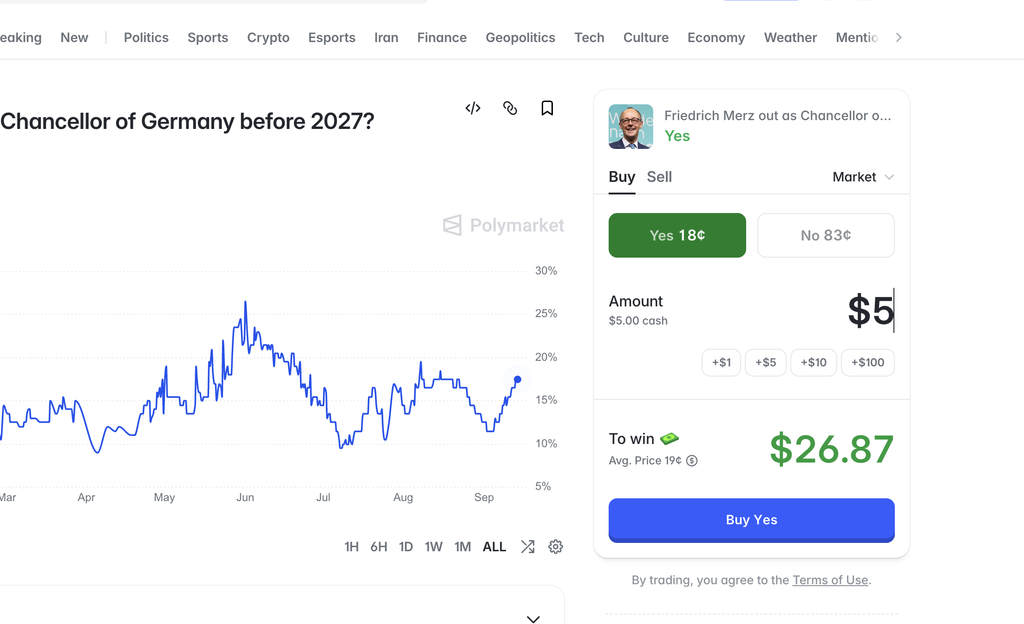
- Pick your side. Yes or No at the top of the panel. The button shows the price you’ll pay.
- Type an amount, or use the +$1 / +$5 / +$10 / +$100 shortcuts. Your available cash sits underneath. The minimum order on this market is $5.
- Read both price lines. The button price is what the market is asking. The Avg. Price line is what you’re actually paying once the fee is in. If they differ, the difference is the fee.
- To win is not your profit. It’s the whole payout if Yes happens, your stake included. $26.87 on a $5 trade is $21.87 of profit, not $26.87.
- Click Buy Yes.
That’s all there is to it. A confirmation box appears and clears itself. No second screen to approve, no signature, no waiting. You own the shares before you’ve finished reading the box. Worth noticing, because nothing on the screen hints that you just spent money you can’t get all of back.
Underneath the panel sits the line “By trading, you agree to the Terms of Use.” That’s the second time Polymarket has asked you to agree to something, the first being the attestation at sign-up. Both are statements you’re making about yourself.
What you own now
The position appears under Portfolio, with columns for your average price, what you traded, what you’d win, and a current value with a profit or loss beside it.

Three things worth understanding about what just happened.
You own shares, not a bet. Each one pays $1 if the outcome happens and nothing if it doesn’t. Between now and then they have a market price that moves.
Your position shows a loss immediately. Mine read minus 2.72% within a second of buying, on a market that hadn’t moved. That’s what it looks like to have paid to get in.
That loss is smaller than the truth. Slow down here, because this one costs money. My screen said I was down 13 cents. Had I sold right then, I’d have been down 57 cents, more than four times as much. Three reasons, and they stack:
- 16 cents. I’d already paid the fee to get in, but the loss is measured against Traded, and the fee isn’t in that number.
- 13 cents. The Value column prices your shares halfway between what buyers are offering and what sellers are asking. Nobody can sell at halfway. You sell to a buyer, at the buyer’s price.
- 15 cents. The fee to get out hasn’t been charged yet, so nothing on screen counts it.
None of this is Polymarket doing something sneaky. Value is an estimate of what your shares are worth, not an offer of what somebody will hand you for them. The trouble is that the screen shows you one number and most people read it as the other.
Getting out
This is what makes a prediction market different from a bet with a bookmaker, and it’s the part the walkthroughs skip.
You don’t have to wait for the answer. Hit Sell on the position and you can close it whenever the market is open, at whatever the current bid is.
You don’t have to close all of it either. The dialog gives you a slider at 0, 25, 50, 75 and 100 per cent of your shares, so you can take part of it off and leave the rest running.
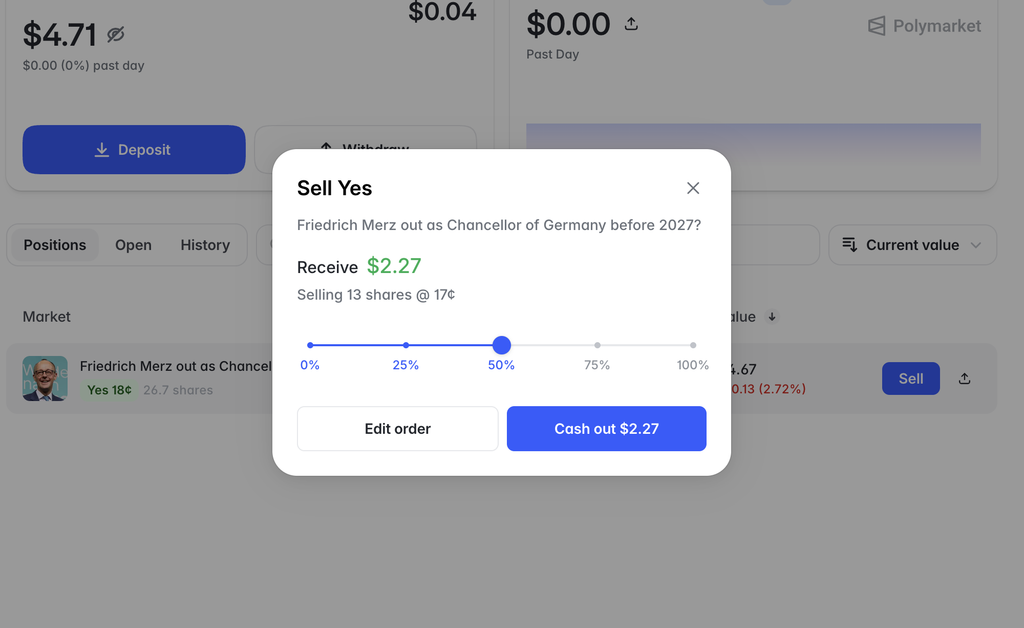
And the fee does it to you one more time on the way out. The box said “Receive $2.27”. The button said “Cash out $2.27”. What turned up in my balance was $2.19. The missing 8 cents is the fee to get out, and Receive is a strange word for a number you don’t receive.
So, the full round trip on the half I sold. $2.48 of my money went in. $2.19 came back. Twenty-nine cents gone in under an hour, on a market that had moved half a cent. That’s the 12% from the top of this guide, in coins.
One relief: the $5 minimum is for buying only. I sold 13 shares for $2.27 and nothing complained, so a small position isn’t stuck.
Three reasons to use it, all more common than holding to the end:
Your view changed. News came out, you were wrong, and no rule says you have to ride it to zero.
The price moved your way. Bought at 18¢ and it’s 30¢? You can take that now. Holding for resolution to collect the last 70¢ means carrying the risk of being wrong for months, for a return you might not need.
You need to know the exit is real. On a first trade, sell part of the position just to watch the mechanism work. It costs you the spread and a second fee, and that’s the tuition for knowing you can leave.
If you hold to resolution
Nothing to do. The market resolves against its source, winning shares pay $1 each, losing shares pay nothing, and the money appears in your balance.
This is also the moment a disputed resolution stops being theoretical. If the market you picked had fuzzy rules, here is where it costs you, which is why the third filter in guide 4 exists and why resolution risk has its own article.
Write it down
One sentence, straight after you trade, somewhere you’ll find it later. It should read like this:
Bought Yes at 18¢, $5, because I think the true chance is closer to 30%, because [reason]. Will sell if it reaches 30 or if [specific thing] happens.
In a month that note tells you something no profit-and-loss figure can: whether you were right for the right reason, right for the wrong reason, or wrong in a way you can fix. That distinction is what shows whether you’re improving.
What a first trade should feel like
Slightly boring, and slightly disappointing that $5 doesn’t feel like anything.
That’s correct. The point of a first trade isn’t the return. It’s discovering that the process has no magic in it: you pay to get in, you own a thing, the number moves, you can leave. Once that’s dull, you’re in a position to decide whether any of this is worth your time.
If it feels like a rush instead, that’s information too, and the first-month guide covers what to do about it.
That’s the series
Five guides, from an empty screen to a closed position. The hub has all of them if you want to go back over anything.
FAQ
Does Polymarket charge trading fees?
Yes, on most categories. Takers pay a fee of shares × rate × price × (1 − price), where the rate is 0.04 on politics, finance and tech, 0.05 on sports and several others, and 0.07 on crypto. Makers pay nothing. Geopolitical and world events markets are fee-free. There is no Polymarket fee to deposit or withdraw.
Why does a one-cent spread cost more than 1%?
Because it’s measured against the price you paid. On a contract at 18¢, buying at 18 and selling at 17 is 5.6% before fees. On a 90¢ contract the same penny is about 1%, and on a 5¢ contract it’s 20%.
What does a round trip actually cost?
On a politics market at 18¢, about 12% of a $5 stake once the taker fee is counted on both sides. Less than half of that is the spread.
What’s the minimum trade on Polymarket?
$5 to buy on this market. Selling has no such floor: I closed half a position for $2.27 without trouble, so a holding worth less than $5 isn’t stuck.
Can I sell before the market resolves?
Yes, any time the market is open, at the current bid. That’s the structural difference between a prediction market and a bet with a bookmaker.
Why does my position show a loss right after I buy?
Partly the spread, but that’s only a third of it. The number on screen is smaller than your real loss, because the fee you paid to get in isn’t counted, the Value column prices your shares halfway between the buy and sell price, and the fee to get out hasn’t happened yet. Mine showed minus 13 cents when selling would have cost me 57.
Should I use a market order or a limit order for my first trade?
A market order, so you learn the process. Understand that it costs you the spread plus a taker fee. A limit order resting in the book pays neither.
What happens when the market resolves?
Winning shares pay $1 each, losing shares pay nothing, and it settles automatically.
How much should I trade first?
An amount you’ve already written off. $5 teaches the same lesson as $500. (How much to bet)
Nothing here is financial advice. Prediction markets involve real risk, so never trade money you can’t afford to lose.