
The biggest number on the page matters least. The number that decides what your trade costs is hidden under a heading most people scroll past.
That inversion is worth knowing before anything else, because the page is laid out by prominence and you need to read it by risk.
Guide 3 of 5. Screens as of August 2026. Covers Polymarket Global.
This guide assumes you know what a price means. If not, read How to Read Prediction Market Prices first. Five minutes. Everything below depends on it.
I’ll use one market throughout: Clarity Act (H.R.3633) signed into law in 2026?, priced at 25% when I took these screens.
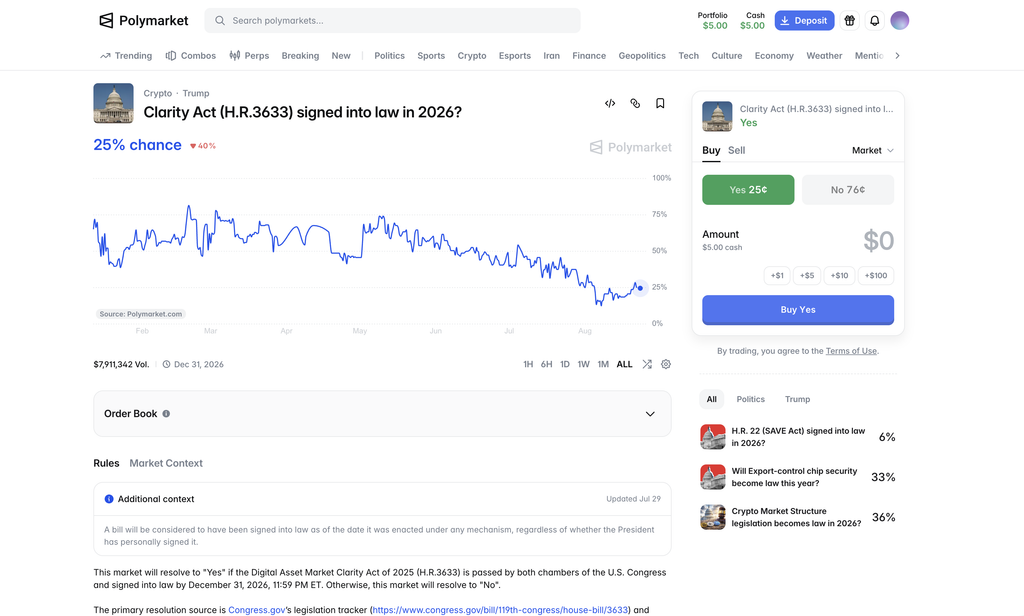
Three things on this page decide whether the trade is worth making. In order:
- The rules, because they decide what you’re actually betting on.
- The spread, because it decides what trading costs.
- The order book, because it decides whether you can get out.
Everything else is furniture. Here’s each of the three.
1. The rules, and when they changed
Below the chart sit two tabs: Rules and Market Context. Rules is the only tab that can cost you money.
On this market it reads:
This market will resolve to “Yes” if the Digital Asset Market Clarity Act of 2025 (H.R.3633) is passed by both chambers of the U.S. Congress and signed into law by December 31, 2026, 11:59 PM ET. Otherwise, this market will resolve to “No”.
Then the line I look for first: the primary resolution source is Congress.gov’s legislation tracker, with a link to the exact bill.
That’s a well-written market. You know the event, the deadline to the minute with a timezone, and the single source that settles it. Plenty of markets aren’t this clear, and the murky ones are where money disappears without anyone doing anything wrong.
Three questions, thirty seconds, every time: what exactly resolves this, who says so, and by when.
Now the part almost nobody checks. Above the rules on this market sits a box headed Additional context, stamped Updated Jul 29. It says a bill counts as signed into law as of the date it was enacted under any mechanism, whether or not the President personally signed it.

Read the stamp again. The rules of this market were added to in July, after people had been trading it since February.
Here the clarification is helpful and hurts nobody. It closes a genuine ambiguity before anyone had to fight over it, which is what a well-run market should do. But the mechanism is the same one that has already cost traders real money elsewhere: a market that resolved against a documented SEC filing turned on wording added after trading closed, and it ended up in court. That story is here.
So make it a habit: check whether there’s an Additional context box, and check its date. Rules added after you took a position still apply to you.
2. The spread, hiding in plain sight
The order panel shows Yes 25¢ and No 76¢.
Add them: 101¢. Buying both sides would cost $1.01 to guarantee a payout of exactly $1.00, and that missing cent is the cost of trading rather than the cost of the outcome.
Add the two prices before every trade. Close to 100 means a tight market. Well above it means you pay to get in and pay again to get out, and on quiet markets that gap gets ugly. The costs note covers why it matters more than beginners expect.
There’s also a dropdown reading Market at the top of the panel. Switch it to a limit order and you name your own price instead of paying whatever’s on offer. Best way there is to stop paying the spread, and a Going Deeper subject rather than a first-week one.
3. The order book, closed by default
Under the chart, a section labeled Order Book, collapsed. Open it.
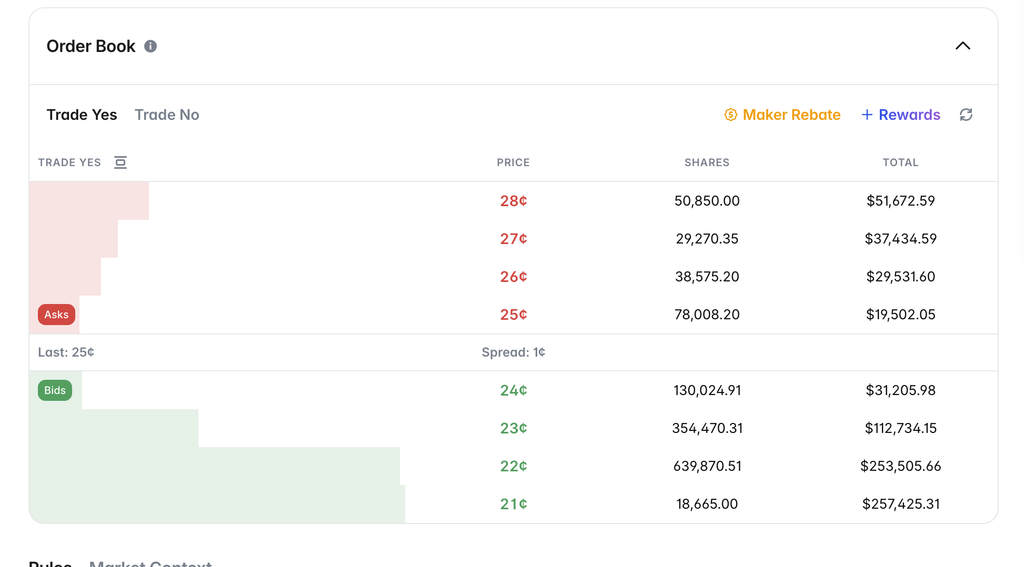
Viewed from the Trade Yes side, ours looked like this.
Asks, in red, people offering to sell:
| Price | Shares | Total |
|---|---|---|
| 28¢ | 50,850 | $51,672 |
| 27¢ | 29,270 | $37,434 |
| 26¢ | 38,575 | $29,531 |
| 25¢ | 78,008 | $19,502 |
Last: 25¢ · Spread: 1¢
Bids, in green, people offering to buy:
| Price | Shares | Total |
|---|---|---|
| 24¢ | 130,024 | $31,205 |
| 23¢ | 354,470 | $112,734 |
| 22¢ | 639,870 | $253,505 |
| 21¢ | 18,665 | $257,425 |
Four things to read.
The spread is printed for you. 25¢ to buy, 24¢ to sell, one cent apart, stated outright. No math needed.
Shares is that price. Total is everything up to it. At 25¢ there are 78,008 shares available, worth $19,502. The $29,531 on the 26¢ row isn’t what sits at 26¢; it’s what you’d spend clearing the book from 25¢ through 26¢. Cumulative, not row by row.
This is where you find out whether your own order will push the price. With nearly $20,000 resting at the best ask, a $5 order and a $500 order both fill at 25¢ and never touch the second row. Buy $30,000 and you pay 25¢ for some and 26¢ for the rest. That’s slippage, visible in advance, which is the whole reason to open this panel before trading instead of afterwards.
The book explains the order panel. Yes at 25¢ and No at 76¢ came to 101. Look again: 100 minus 76 is 24, exactly the best bid. The No price mirrors what you’d get selling Yes. So the relationship underneath is exact: Yes plus No, minus 100, is the spread.
The liquidity note explains how to use what you find in here.
The two badges in the corner
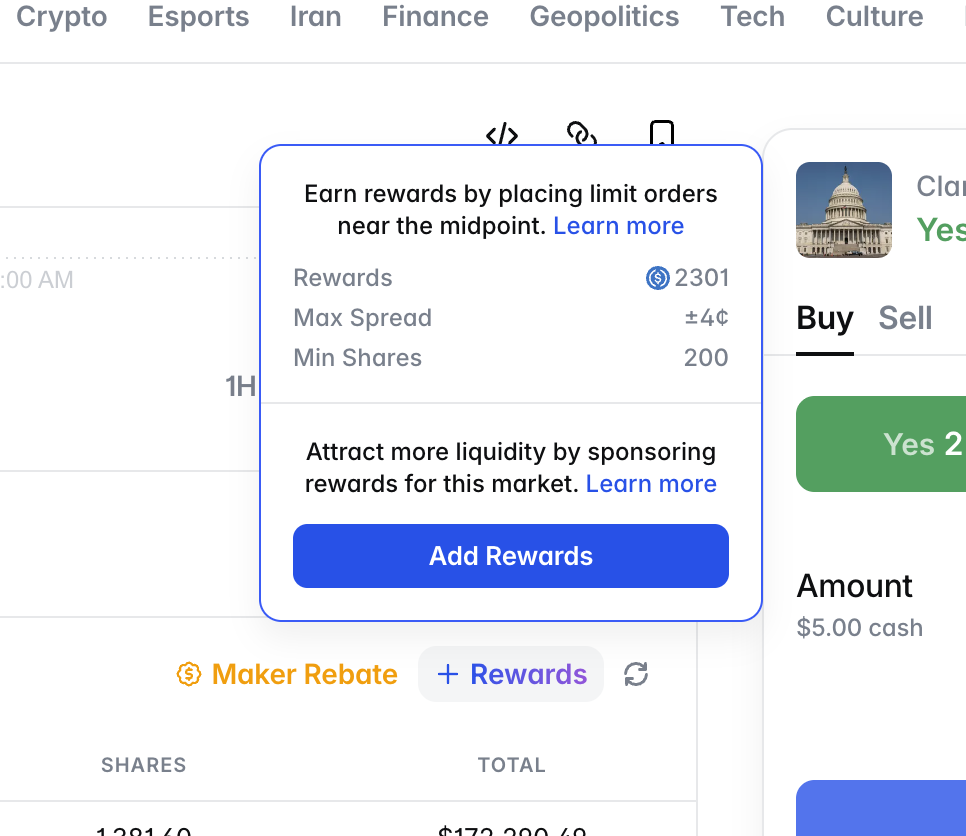
Maker Rebate pays you daily in USDC when a limit order you posted gets filled. Rewards is a separate pool: keep limit orders within 4¢ of the midpoint, at least 200 shares, and you earn a share of it. This market’s pool held 2,301 when I looked.
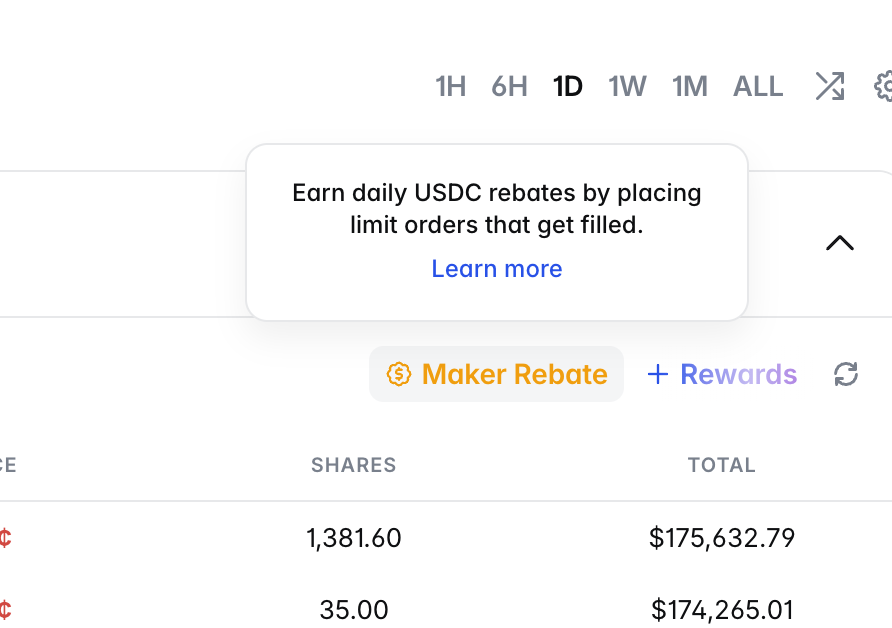
Both pay you for adding liquidity rather than taking it, and both are worth leaving alone for now. They pay you to keep orders resting on the book, which means they pay you to hold a position you might not otherwise want, at a price you might not otherwise choose. Sensible for someone running a market-making strategy. For someone still learning to read this page, it’s an incentive to trade for the wrong reason.
One detail in there is more interesting than the money. Next to Rewards is an Add Rewards button: anyone can sponsor a market’s reward pool to attract limit orders to it. So a market can look tight and deep because somebody is paying for it to look that way. Nothing improper, and it genuinely helps traders. It does mean depth isn’t always evidence of interest, and sponsored depth stops when the sponsor does.
The furniture
Volume ($7,911,344 here) counts everything traded since the market opened. It’s a record of past activity, not a promise anyone will trade with you now. The order book answers that.
The closing date (Dec 31, 2026) sits beside it. On short markets you’ll see a countdown in minutes instead.
The chart with its 1H to ALL buttons is worth one glance, to see whether today’s price is normal for this market or a fresh move. Ours sat in the 50s and 60s for months and slid to 25 over the summer, which is a different situation from a price that has been 25 all year.
The change figure beside the price is tied to the timeframe you’ve selected and measured in percentage points. With ALL selected it read 40, meaning a fall of about forty points since the chart begins. Switch to 1D and it vanishes, because the market barely moved that day. That blank space is information: nothing happened on the timeframe you’re looking at.
Market Context, the tab beside Rules, holds background on the question.
What the screen won’t tell you
Whether the price is wrong. It shows what the crowd believes and has no view on whether the crowd is right. Your profit lives entirely in that gap.
Whether you understand this question. The interface makes every market look equally tradable. A bill you’ve followed for months and a bill you first heard of on this page look identical here, and they are not the same trade.
FAQ
What does the percentage on a Polymarket market mean?
The market’s implied probability. 25% means the crowd is pricing roughly a one-in-four chance.
Why don’t Yes and No add up to 100?
The difference is the spread, the cost of trading. On this market they came to 101¢, so buying both sides costs $1.01 to receive $1.00.
Does Polymarket have an order book?
Yes, in a collapsible section under the chart, closed by default. It shows the orders waiting at each price and how much money sits behind them.
What does Total mean in the order book?
The cumulative cost of clearing every order from the best price through that row, not the value of that row alone.
Where are the resolution rules?
In the Rules tab below the order book. Some markets label it Resolution. A well-written market names the exact event, the deadline with a timezone, and the source that settles it.
What is the Additional context box?
Clarifications added to a market’s rules after it opened, with the date. Worth checking, because rules added after you traded still apply to you.
What are Maker Rebate and Rewards?
Two programs that pay you for placing limit orders rather than taking existing ones. Useful for liquidity providers, and a distraction while you’re learning.
What does Vol mean?
Total traded since the market opened. History, not availability.
Nothing here is financial advice. Prediction markets involve real risk, so never trade money you can’t afford to lose.